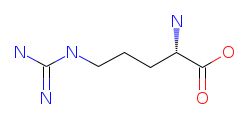
The amino acid with the longest side chain, the highest pKa, and a starring role in getting rid of the body's most toxic waste.
Symbol
Arg · R
Discovered
1886
Mol. Weight
174.20 g/mol
Essential
Conditionally
R
Discovery: From Lupine Seeds
L-Arginine
In 1886, German chemist Ernst Schulze and his assistant Ernst Steiger were working with extracts from germinating lupine seedlings — the same legume grown for centuries in Mediterranean agriculture. Using the chemical fractionation methods of the era, they isolated a new crystalline compound with unusual properties: it was strongly basic, far more so than any amino acid known at the time. They named it arginine, from the Greek árgyros (ἄργυρος, meaning silver), because of the silver-white appearance of arginine nitrate crystals.
By 1895, arginine was recognized as a component of casein and confirmed to be widely distributed across food and feed proteins. What made arginine interesting wasn't just its basicity — it had the most elaborate side chain of any amino acid discovered to that point: a four-carbon chain capped by a guanidinium group, a flat, triangular structure carrying a strong positive charge. That unusual chemistry would later turn out to be central to some of the most important reactions in metabolism.
☠️ The Urea Cycle: Arginine vs. Ammonia
Proteins contain nitrogen. When cells break down proteins for energy, that nitrogen gets released — and free ammonia (NH₃) is one of the most toxic substances a body can produce. Even small concentrations in the bloodstream cause neurological damage. Every animal that eats protein has to solve the ammonia problem.
The solution, discovered by Hans Krebs and Kurt Henseleit in 1932, is the urea cycle — a series of reactions in the liver that converts toxic ammonia into harmless urea, which is then excreted in urine. Arginine is the central molecule of this cycle: it carries the nitrogen atoms and is cleaved at the end to release urea, regenerating ornithine to start the cycle again. Without arginine chemistry, eating protein would be lethal.
Of all the standard amino acids, arginine has the highest side chain pKa — approximately 12.48 — which means its guanidinium group carries a positive charge under virtually all physiological conditions. This isn't true of the other basic amino acids: histidine loses its charge near neutral pH, and lysine, while reliably positive, has a lower pKa than arginine. The guanidinium group of arginine is uniquely stable in its charged form.
This reliable positive charge makes arginine enormously useful for DNA-binding proteins. DNA is negatively charged along its phosphate backbone, and arginine residues on histone proteins interact directly with those negative charges to package DNA tightly into the nucleus. The way your genome is stored and organized depends in part on arginine's permanent positive charge.
Arginine and Nitric Oxide
In 1998, the Nobel Prize in Physiology or Medicine was awarded for the discovery that nitric oxide (NO) acts as a signaling molecule in the cardiovascular system. Where does the body get its nitric oxide? Largely from arginine. The enzyme nitric oxide synthase converts arginine into citrulline and NO. That nitric oxide causes blood vessel walls to relax, widening the vessels and reducing blood pressure.
This biochemical pathway was entirely unknown before the 1980s — the idea that a simple gas molecule could carry biological signals was considered implausible. The arginine-to-nitric-oxide connection opened an entirely new chapter in understanding how the circulatory system is regulated.
Did You Know?
The 1998 Nobel Prize in Medicine was awarded for discovering that nitric oxide is a biological signaling molecule. The body makes that nitric oxide primarily from arginine — a discovery nobody suspected until the 1980s.
Functions of L-Arginine in the Body
Arginine is a conditionally essential amino acid — adults can synthesize it, but not always in sufficient quantities during rapid growth, serious illness, or recovery from injury. In those circumstances, dietary intake becomes important.
Cell division and tissue growth
Arginine plays a direct role in cell division and protein synthesis across a wide range of tissues. Its role as a nitrogen-rich intermediate makes it particularly important during periods of rapid cellular growth.
Immune function
Arginine is required for the activation and proliferation of T-lymphocytes and other immune cells. Adequate availability is important for a normal immune response, particularly after injury or surgery, when immune demand increases significantly.
Wound healing and post-surgical recovery
Arginine supports wound healing through multiple mechanisms: it promotes collagen synthesis, stimulates growth hormone release, and provides the substrate for nitric oxide that drives local blood flow to injured tissue. Clinical research has shown that arginine supplementation, particularly in combination with other nutrients, can help reduce recovery time and lower infection risk after surgery.
Hormone release
Arginine stimulates the release of growth hormone, insulin, and glucagon. This has made it a subject of interest in clinical nutrition and sports science, though practical effects in healthy adults are modest and context-dependent.
Cardiovascular health
Through its role as the precursor to nitric oxide, arginine contributes to vascular tone and blood pressure regulation. Research has shown improvements in blood vessel function and reduced symptoms in patients with angina and peripheral arterial disease. However, results vary between individuals, and arginine is not a substitute for established cardiovascular treatments.
Argininemia
Argininemia is a rare inherited metabolic disorder caused by a deficiency of arginase — the enzyme responsible for breaking down arginine in the final step of the urea cycle. The deficiency leads to abnormally high levels of arginine in the blood and cerebrospinal fluid.
Symptoms typically appear in early childhood and may include progressive spasticity, developmental delays, seizures, and intellectual disability. Unlike most other urea cycle disorders, acute hyperammonemia is less prominent; neurological damage is thought to result primarily from arginine accumulation itself. The condition is autosomal recessive.
Treatment involves dietary restriction of arginine and protein, combined with nitrogen-scavenging medications. Early diagnosis through newborn screening is critical — prompt intervention significantly improves long-term outcomes.
Interesting Facts
🏆
6 codons — tied for the most. Arginine shares the record with leucine for being encoded by the most genetic codons: CGU, CGC, CGA, CGG, AGA, and AGG. This genetic redundancy reflects how important arginine is — evolution seems to have provided multiple backup routes to ensure it can always be incorporated into proteins.
📏
Longest side chain. With a four-carbon chain plus the guanidinium group, arginine has the longest side chain of any standard amino acid. This length allows it to reach deep into grooves on DNA and RNA molecules, making it a preferred residue in proteins that need to grab and hold nucleic acids.
🔬
Semi-essential. Adults can synthesize arginine, but not fast enough during growth, stress, or illness to meet all demands. Children cannot synthesize enough at all. This makes arginine "conditionally essential" — a classification that reflects how the line between essential and non-essential can shift depending on circumstances.
🌱
Abundant in seeds. Germinating seeds are rich in arginine because it's an efficient nitrogen storage molecule — the guanidinium group packs four nitrogen atoms into one side chain. When a seed germinates, arginine is broken down to release that stored nitrogen for building new proteins in the growing seedling.
Where Arginine Is Found
Arginine is particularly abundant in seeds and animal proteins. Plant-based sources are also significant, making it accessible across both omnivorous and vegetarian diets: